

Ojibwe Migration and History

The Ojibwe, or Chippewa, people call themselves Anishinaabe, meaning “original people.” They may have gotten the name Ojibwe from the special moccasins they wore, which had puckered seams.
Many centuries ago, the Ojibwe people lived in the northeast along the Atlantic coast. A series of prophecies prompted them to begin a centuries-long migration westward to the Great Lakes region. The time of this migration is debated, but said to be around 1500, or 500 years ago. The prophecies known as The Seven Fires contained seven predictions of the future; the third prophecy told of a place where food grows on water, referring to wild rice. When the Ojibwe reached the Great Lakes region they ultimately split into two groups, with the southern branch becoming known as the Lake Superior Chippewa and settling on Madeline Island where the wild rice from the prophecy grew.
Today, the Ojibwe people live around the Great Lakes region in the US and Canada. Like the Menominee, the Ojibwe people are still living on portions of their ancestral land.
For more information, please visit:
For more information on The Seven Fires prophecy:
Native Medicine Wheels & The Four Sacred Medicines
Medicine wheels are sacred symbols often used for ceremonies and healing. Although teachings and beliefs around them vary between communities, the core idea is the same: the medicine wheel is a sacred circle that represents the interconnectedness of life.
Medicine wheels have four quadrants, each corresponding to a specific direction (north, east, south, or west) and color (red, yellow, white, and black). These quadrants may also symbolize different things depending on the tribe. For instance, in some Indigenous cultures, they represent seasons, stages of life, animals, or elements. Each quadrant also corresponds to one of the four sacred medicines: tobacco, cedar, sweetgrass, and sage. These medicines are often used for smudging, which is the practice of burning sacred herbs to cleanse or bless a person, place, or object. Each medicine has its own purpose and story. Physical medicine wheels, often built out of stone or wood, are traditionally considered sacred spaces for ceremonies and rituals.
Ojibwe Medicine Wheel


The Four sacred medicines: tobacco
Considered the first gift the creator gave Native people, tobacco leaves are given as an expression of gratitude. It is said that it was given to Native people so that they could communicate and connect with the spirit world, and that it activates all other plant spirits. It symbolizes harmony and peace, and as such it is used ceremonially in peace pipes. However, it’s important to distinguish traditional native tobacco from the commercial tobacco used in cigarettes: commercial tobacco has been engineered to be more addictive and is carcinogenic (cancer-causing) when consumed. Native people discourage commercial tobacco use in order to keep the medicine sacred.


The Four sacred medicines: Cedar
Cedar is a type of evergreen tree. Its bark or leaves can be made into a tea or salve and used to treat many types of infections. It is considered a restorer and a purifier, and so can be burned as incense to purify your home. It is also used in sweat lodge ceremonies.


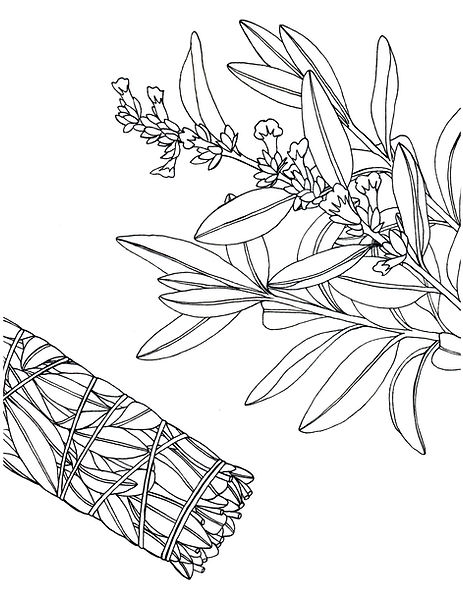
Sage is an herb that is often used ceremonially, specifically to prepare people for ceremonies and clear what is no longer needed, such as negative thoughts or energy. The leaves can also be made into a poultice to treat injuries like sprains or swelling, or into tea to treat coughs.
The Four sacred medicines: sage

Sweetgrass is considered the sacred hair of Mother Earth. Much like cedar, it is a purifying plant often burned as incense or made into tea. Sweetgrass has a sweet, vanilla-like scent, and it is said that the sweet-smelling smoke helps communicate messages to the spirit world. Sweetgrass is traditionally braided in three bunches of seven strands of grass, for 21 strands in total. The first seven strands are said to represent the seven generations behind us, the second set represents the seven sacred teachings (Love, Respect, Honesty, Courage, Wisdom, Truth and Humility), and the third represents the seven generations in front of us.
The Four sacred medicines: sweetgrass
