

Black Ash
black ash (fraxinus nigra) ID
-
Bark - Black Ash bark is a grayish-brown color with a flaky or scaly texture that easily rubs off. Bark texture can be ridged on older growth.
-
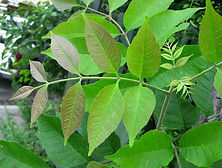
Leaves - Black Ash has compound leaves, meaning each leaf is made up of multiple leaflets connected to a main stem. In this case, the leaflets are opposite–or directly across from–one another. Black ash typically has 7-11 leaflets connected directly to a stem which turn yellow in the fall. The leaves’ edges are always serrated.
Paul Wray, Iowa State University, Bugwood.org (left), Keith Kanoti, Maine Forest Service, Bugwood.org (right)
-
Fruit/Seeds - Ash trees produce samaras, which are winged seeds. If you’ve ever seen a maple tree seed (also known as helicopters or whirligigs), you have seen a samara! Black Ash samaras are very flat and oval or canoe shaped.
-
Habit - Black Ash trees are medium size trees, usually 35-75ft. tall and 1-2ft. in diameter. Their trunks are often straight and slim, although they can be crooked.
-
Range & Habitat - Black ash is common in the northeastern areas of the U.S. and in southeastern Canada around the Great Lakes region. Black ash prefers moist to wet soil, and tends to grow in swamps, floodplains, or other wetlands.


Black Ash vs. green and white ash
-
Bark - The best way to tell these trees apart is by their bark. Unlike Black Ash, Green and White Ash have ridged, diamond patterned bark.
Black Ash Green Ash White Ash
Keith Kanoti, Maine Forest Service, Bugwood.org (far right)
-
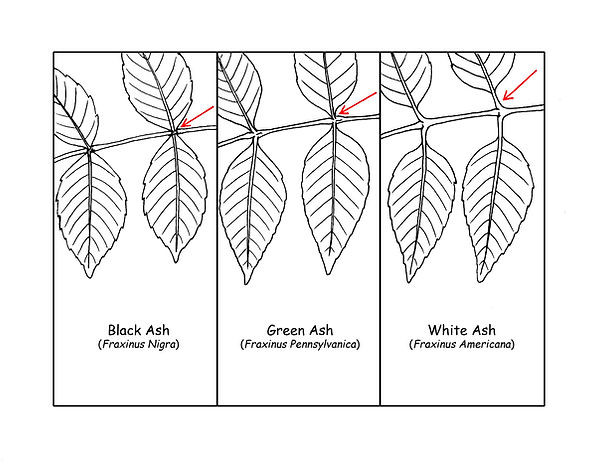
Leaves - You can also tell these trees apart by looking carefully at their leaves. Whereas Black Ash typically has 7-11 leaflets, Green and White Ash have 5-9. The Green Ash leaflets are attached to the stem by short, winged stalks, and White Ash leaflets are attached by longer stalks. Remember: Black Ash leaflets are always attached directly to the stem, and their edges are always serrated.
Black Ash Green Ash White Ash


.jpg)


.jpg)
Emerald Ash Borer
The emerald ash borer, or EAB, is an invasive beetle from northeastern Asia that kills ash trees. Females lay their eggs in crevices in the ash tree’s bark, and the larvae then eat the tissue underneath the bark, emerging in two years as adults. This tissue is how the tree transports nutrients; without it, the tree cannot survive. The tracks left by the larvae can often be seen on dead trees. The beetle has devastated ash populations in Europe and North America and is a real threat to the Indigenous tradition of black ash basket weaving. In order to prevent the spread of this beetle, it’s important not to transport ash products, as one of the main ways it spreads is through the movement of firewood. Adult beetles can be identified by their metallic green color and red abdomen that’s visible when their wings are spread.


Weaving
Black ash has long been used by many tribes in basket weaving due to the unique properties of the tree. It is flexible enough for weaving, and airy enough that its growth rings separate easily when the tree is pounded. This allows thin, pliable splints to be cut from the tree and used for basket weaving. Baskets are traditionally used as packs, for corn washing and sifting, and for drying and storage.
1. “Native Hands” article/blog 2. Alice Ogden black ash baskets
However, not every tree is suitable for this task. Black ash trees must be carefully evaluated before they are felled to be made into baskets. The rings cannot be too wet or too dry, and their thickness is important as well. The ideal thickness basketmakers look for is 3 to 5 millimeters. To determine this, basketmakers will cut a notch into the tree using an axe to examine the visible growth rings. If all the correct conditions are met, the tree will be felled. At this point, the log will be pounded, typically with the back of an axe, causing the rings to separate and form thin layers of wood. These layers are then further refined into the splints needed for basket weaving.
3. Eric Taylor Basketry 4. “Native Hands” blog
Black ash splints have been used historically among many tribes for several types of baskets, although the Oneida tribe’s baskets are mainly utilitarian. One such type is a basket made specifically for washing and sifting Oneida white corn. As the tradition evolved, more ornate and decorative baskets were created for the purpose of selling to outsiders and tourists. Although they deviate from the traditional purpose of basket weaving, these baskets allow for more artistic expression from the weaver.
5. Ukwakhwa corn pounding workshop baskets 6. Large basket for carrying


Other Uses
Black ash leaves may be used in tea to treat a myriad of internal issues, such as to treat painful urination, as a diaphoretic, a worm remover, a tonic for the liver and stomach, or to stimulate bowel movements. Its roots can also be made into tea.
The wood may be used for construction or in furniture-making. It is similar to oak in appearance when stained and is comparatively low in cost. It is generally considered easy to work with in woodworking, and is preferred over white ash in machining due to its lower likelihood of splintering.
In addition to baskets, black ash wood may be used to create scoops, or handles for other tools. It has also been used for snowshoes, Lacrosse sticks, and canoe seats, paddles, or yokes.