

The Oneida Nation Migration Story

The Oneida people call themselves onʌyoteˀa·ká·, or “People of the Standing Stone.” The name comes from the large stones the Oneida used for their ceremonies and gathering places; legend has it that the Oneida Stone would lead the people to their new village as they moved around New York. The Oneida were also original members of the Haudenosaunee Confederacy, or “People of the Longhouse,” a confederacy that united the five nations of Oneida, Mohawk, Onondaga, Cayuga, and Seneca (and later Tuscarora).
During the early 1800s, The United States Removal Act was designed to move all Native Americans west of the Mississippi river. After much of their land was taken from them through a series of illegal treaties, the Oneida Nation was coerced into leaving their original homelands in what is now New York State and relocated to Green Bay, Wisconsin where they entered into treaties with the Menominee and Ho-Chunk tribes. After the move, the Oneida faced pressure from government assimilation policies such as boarding schools that prevented a majority from practicing most of their cultural traditions, but since the 1970s there has been a push to reclaim their history, language, and ceremonies. Today, the Oneida continue working to ensure the preservation of their culture, and have successfully re-established their agriculture and language here in Wisconsin.
For additional resources, please visit:
White Corn
There are six main types of corn grown in the U.S.:
-
Dent or field corn is the kind of corn used to feed animals. You can identify dent corn by the dent that forms on top of the kernels.
-
Sweet corn is the kind of corn you are probably most familiar with, as it’s the kind you will usually find at the grocery store.
-
Flint corn is known for its hard outer shell. Flint corn can come in many colors, and is one of the varieties often grown by Indigenous peoples.
-
Popcorn doesn’t come from just any corn–it’s actually a special kind of corn with a hard shell whose kernel turns inside out when heated.
-
Flour corn is soft and easy to grind into cornmeal to use in baked goods. Like flint corn, it also comes in a variety of colors and is often grown by Indigenous peoples. Oneida White corn (or Tuscarora corn) is an heirloom type of flour corn.
-
Pod corn is a unique type of corn that grows small leaves around each kernel which can help protect it from pests and diseases. This corn isn’t usually eaten.

White Corn
As the Oneida people are originally from the state of New York, the white corn they planted during their forced relocation to Wisconsin was not native. The Oneida had to re-establish their agriculture in an entirely new environment. However, the people were able to overcome the agricultural challenges, and this same white corn is still grown and harvested today.
White corn is characteristically different from the more common feed corn or sweet corn found in the US. Besides the obviously differing off-white color, white corn can be distinguished from other varieties by its shape: long and skinny, with exactly eight rows of corn on every cob. Additionally, it’s unique in that it is very difficult to harvest with mechanical farm equipment. The seed size varies too much, as does the stalk height, which can even get too tall for conventional farming equipment. As such, it must all be harvested by hand, although some white corn growers are working on innovative ways to mechanize the process in order to increase the volume of white corn they are able to provide to their community.
White corn is considered one of the Three Sisters, or “Sustainers of Life,” along with beans and squash. When grown together, these three plants are known as a Three Sisters Garden, and they provide for each other to produce a better harvest. Once harvested, white corn is braided and hung to dry. The seeds of the best ears are saved for replanting the next year.

Corn Husk dolls
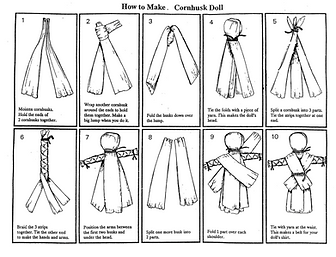
In a variety of cultures, corn husks have been used to create dolls. In the Haudenosaunee Confederacy (consisting of 5 tribes–Mohawk, Oneida, Onondaga, Cayuga, and Seneca), corn husk dolls are made without faces. Stories of why this came to be vary slightly, but the lesson remains the same. As one traditional story goes, the Corn Spirit was one of the Three Sisters, along with Beans and Squash. These sisters were also known as the sustainers of life, and the Corn Spirit was so honored to be one of these sustainers of life that she wanted to do more for her people. The Great Spirit told her that dolls could be made from her husk, so the Corn Spirit made this doll and gave it a beautiful face. The doll then went to many villages to play with the children there. As she travelled, people kept telling her how beautiful she was, to the point where she became conceited and vain. After warning her, the Great Spirit punished her repeated offense by removing her face, which she had been admiring in a pool of water. Since then, corn husk dolls have always been made without faces, to remind people never to think they are better than anyone else.

Corn Husk Uses
Besides dolls, corn husks can be woven into a variety of useful objects. Importantly, the husks are used to braid white corn together when preparing to hang it up to dry. Other uses of corn husks include masks and baskets that are used in religious ceremonies, as well as mats and rugs made by circling a braid around itself.
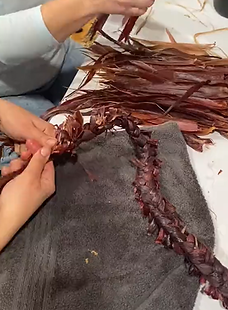


https://www.tiktok.com/@ukwakhwa/video/7322132802907147566 Mats being constructed
Recipes
From Rebecca Webster and Laura Manthe: Corn Mush
Ingredients:
-
1 quart shelled dry white corn
-
1 cup sifted hard wood ashes
-
Manthe and Webster have developed a trade with the Menominee tribe to obtain these ashes in exchange for dry white corn.
-
-
4 quarts water (for first boiling), plus extra to add as water evaporates
-
Cold water for rinsing
-
4 quarts water (for second boiling)
Method:
-
Bring water to a boil, add ashes and stir. Add corn and stir often. Boil for one hour adding boiling water every 15 minutes.
-
Remove corn from ash water and rinse in cold water in a metal sieve or metal colander rubbing the corn against the side to remove the hull. (Black ash baskets woven specifically for washing white corn are also used.)
-
Return to fresh boiling water for one hour. Rinse again to remove any remaining hulls.
-
Add to your favorite dish (e.g., bean and ham soup).


From a story card at the Powwow:
Soak corn in water overnight.
Smoked meat - put in kettle + cook until tender (you can also use turkey)
Once tender, add red kidney beans (can is okay)
Cook until tender + combined.
From Becky Webster:

White corn mush recipe: 6 cups of water, 2 cups of mush, ¾ cup of maple sugar
Bring the water to a boil and add the processed corn (made by pounding dried corn by hand). Then add sweetener.
During the workshop we attended (Ukwakhwa workshop), Becky used maple sugar to sweeten the mush, but she mentioned that a variety of different sweeteners in varying amounts may be used.
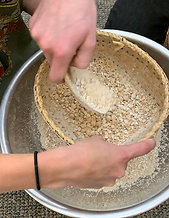
Corn is pounded in hollowed tree stumps, sifted, and boiled to form mush. Then any other ingredients like sweeteners are added.


Recipe Discussion Prompts
-
Are there any recipes that have been passed down in your family?
-
What recipes or foods are important to you or your family? Why are they important to you?
-
Are there any cultural or ancestral foods that are still a part of your family today? Any that you use in your everyday life or on special occasions?
Food Sovereignty Discussion Prompts
-
What does food sovereignty mean to you? If it’s your first time learning about food sovereignty, what do you think it means?
-
Why do you think food sovereignty is important?
-
What do you think are some of the main differences between food systems that are sovereign and food systems that are not?
-
Can you think of any issues with our current food system that food sovereignty could help solve?
-
What are some ways we can work toward food sovereignty? What kind of work are people already doing?